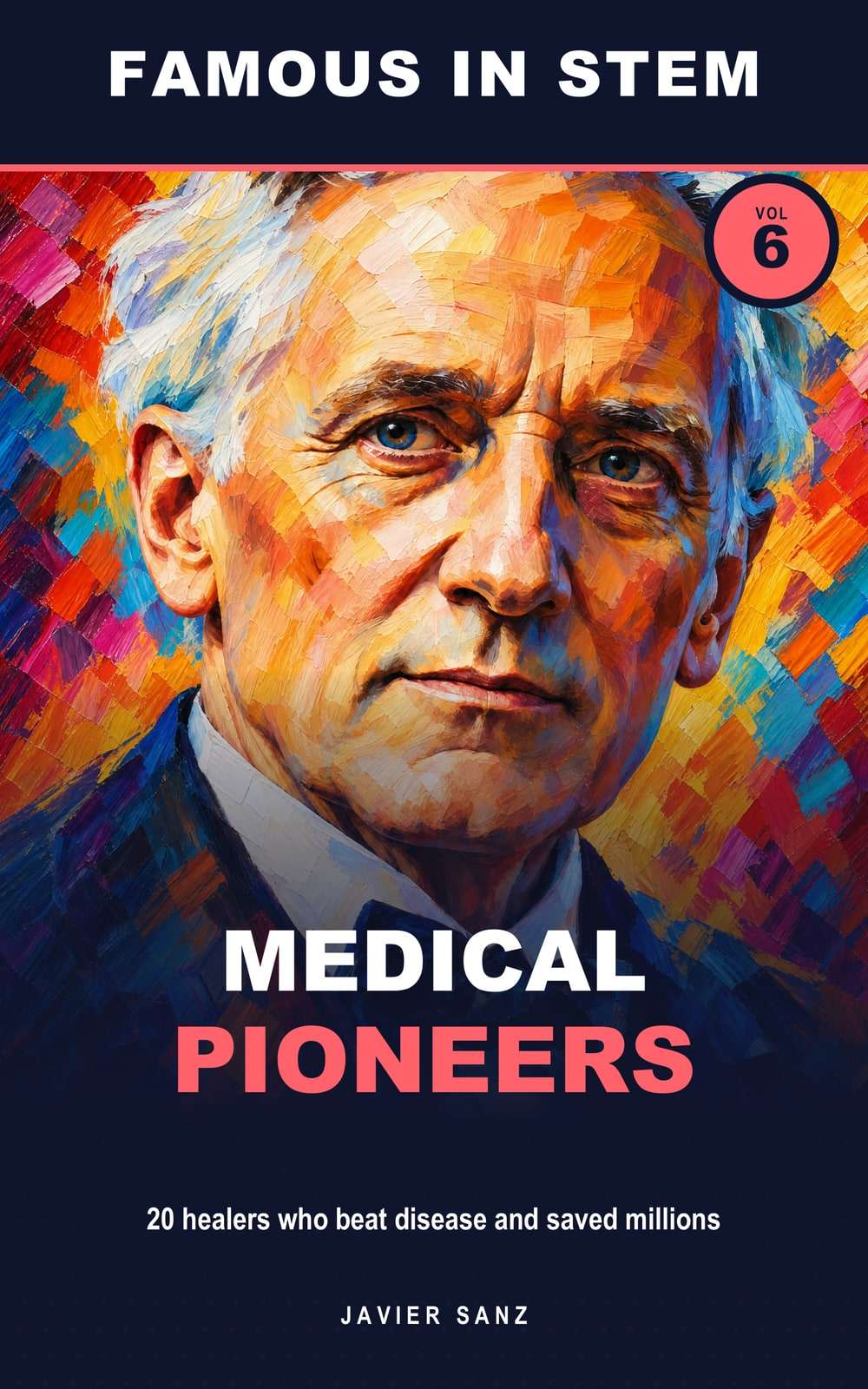
Cover of Famous in STEM, Vol. 6: Medical Pioneers by Javier Sanz, showing a painted portrait of Alexander Fleming

Famous in STEM · Volume 6

Medical Pioneers

20 healers who beat disease and saved millions

A doctor who realized he and his colleagues were carrying death on their own hands. A mold on a forgotten dish that turned into penicillin. A surgeon who mended a wound beside a beating heart in 1893. Medical Pioneers tells the true stories of 20 healers who beat disease and saved millions, from Hippocrates and Ibn Sina to Florence Nightingale, Jonas Salk and Virginia Apgar.

Also see all formats on Amazon, including hardcover where available.

  • 20 chapters
  • Ages 13+
  • Read in any order
  • 2026 edition
  • By Javier Sanz

About this book

Vaccines, antibiotics, hand-washing, blood banks and heart surgery, told through the healers who fought for them.

Each chapter explains one medical idea in plain words: how a vaccine teaches the body, why germs cause infection, how blood circulates, why a newborn gets an Apgar score. Hands-on boxes include taking your own pulse and doing William Harvey’s arithmetic.

I had one wish for this book: that by the last page you would want to know more about medicine, not less.

From “Before you start,” the book’s introduction

Who’s inside

All 20 medical pioneers

Each chapter title and big idea, exactly as they appear in the book.

  1. Alexander Fleming

    1881–1955

    The untidy laboratory that saved millions

    Big ideaA common mold makes a substance that kills bacteria and leaves human cells alone.

  2. Edward Jenner

    1749–1823

    The country doctor who listened to the milkmaids

    Big ideaShow the body something harmless that looks like a deadly germ, and it learns to fight the real thing. Every vaccine since works this way.

  3. Florence Nightingale

    1820–1910

    The nurse who beat the army with a diagram

    Big ideaCount the deaths, work out the rate and draw it so a general can see it in one glance. Numbers save lives.

  4. Jonas Salk

    1914–1995

    The summer the swimming pools reopened

    Big ideaA virus killed with chemicals keeps its shape, so the body can learn to fight it without ever being infected.

  5. Hippocrates

    c. 460–370 BC

    The doctors who wrote down their failures

    Big ideaDisease has natural causes. Watch the patient, write down what you see and learn from what happens.

  6. Elizabeth Blackwell

    1821–1910

    Admitted to medical school as a joke

    Big ideaHalf of all patients are women, and many of them would rather be treated by one. In 1849 the United States had exactly one woman with a medical degree.

  7. Joseph Lister

    1827–1912

    The surgeon who went to war against the invisible

    Big ideaWounds go bad because living germs get into them. Kill the germs and the wound heals.

  8. Virginia Apgar

    1909–1974

    Five checks, ten points, one minute

    Big ideaGive every newborn the same five quick checks and a score out of ten, so nobody has to guess how a baby is doing.

  9. William Harvey

    1578–1657

    The king’s doctor who did the arithmetic on blood

    Big ideaThe heart is a pump, and the blood goes round and round. Count your pulse, do Harvey’s math and see why.

  10. Andreas Vesalius

    1514–1564

    The student who stole a skeleton by night

    Big ideaIf you want to know what is inside a human body, open one and look. Do not take a dead Greek’s word for it.

  11. Daniel Hale Williams

    1856–1931

    The barber’s son who stitched the sac around a beating heart

    Big ideaThe chest is not off-limits. A surgeon with clean hands and steady nerves can mend a wound next to a beating heart.

  12. Christiaan Barnard

    1922–2001

    Eighteen days with another person’s heart

    Big ideaA heart can be moved from one body to another and beat on. The hard part is persuading the new body to let it stay.

  13. Ignaz Semmelweis

    1818–1865

    The doctor who found the killer on his own hands

    Big ideaDoctors were carrying death from the autopsy room to the maternity ward on their hands. Washing them cut the deaths sharply.

  14. Charles Drew

    1904–1950

    The man who taught blood to travel

    Big ideaTake the cells out of blood and the yellow liquid left behind can be stored, shipped and given to almost anyone in an emergency.

  15. Helen Taussig

    1898–1986

    The deaf doctor who listened to hearts with her fingers

    Big ideaMany “blue babies” are blue because too little blood reaches the lungs. Build a detour and send more.

  16. Rebecca Lee Crumpler

    1831–1895

    The doctor whose face nobody remembers

    Big ideaTeach a mother how to keep her children well and you have done more than a dozen doctors who arrive when they are sick.

  17. Harvey Cushing

    1869–1939

    The surgeon who made the brain a place you could go

    Big ideaBrain surgery kills when it is fast and bloody. Go slow, stop every bleed, write everything down, and most patients live.

  18. Paul Ehrlich

    1854–1915

    Hundreds of tries for one magic bullet

    Big ideaA drug can be a bullet that hits the germ and misses the patient. You find it by testing, and testing, and testing.

  19. Galen

    c. AD 129–216

    The gladiators’ doctor who was believed for 1,300 years, and wrong

    Big ideaExperiment on the living body to find out what each part does. Then, unfortunately, write it all down so well that nobody checks it for a thousand years.

  20. Ibn Sina (Avicenna)

    c. 980–1037

    The teenager who cured a king and wrote the book Europe studied for 500 years

    Big ideaA medicine is only proven when it is tested, on people, in the right way. He wrote some of the first rules.

Free sample

Read the opening of Ignaz Semmelweis’s chapter

The first pages, word for word.

Ignaz Semmelweis

The doctor who found the killer on his own hands

Lived: 1818–1865

Big idea: Doctors were carrying death from the autopsy room to the maternity ward on their hands. Washing them cut the deaths sharply.

In the spring of 1847, a young Hungarian doctor came back from a vacation in Venice to the Vienna General Hospital and learned that his friend was dead. Jakob Kolletschka, a professor of forensic medicine, had been performing an autopsy when a student’s scalpel slipped and cut his finger. The infection spread up his arm, and then to the linings of his chest, his belly and his brain. He died of it.

Ignaz Semmelweis read the autopsy report on his friend and went cold. He knew those findings. He saw them several times a week on the bodies of young mothers from his own ward, women who had given birth, developed a raging fever within days and died of childbed fever. Kolletschka had never given birth. What he had in common with the mothers was a wound, and something from a corpse that had gotten into it.

Two doors, two death rates

The maternity hospital in Vienna was one of the biggest in the world, and it had two clinics side by side. The first was run by doctors and medical students, the second by midwives. Women were sent to one or the other depending on the day they arrived. In the doctors’ clinic, in a bad month, nearly one mother in five died of childbed fever. In the midwives’ clinic, next door, with the same food and the same air, it was usually around one in thirty.

Women begged on their knees to be admitted to the second clinic. Some gave birth in the street on the way to the hospital rather than go through the first door, and those women, Semmelweis noticed, hardly ever got the fever at all.

The chapter goes on. So do 19 more.
From the book

See it, try it, think about it

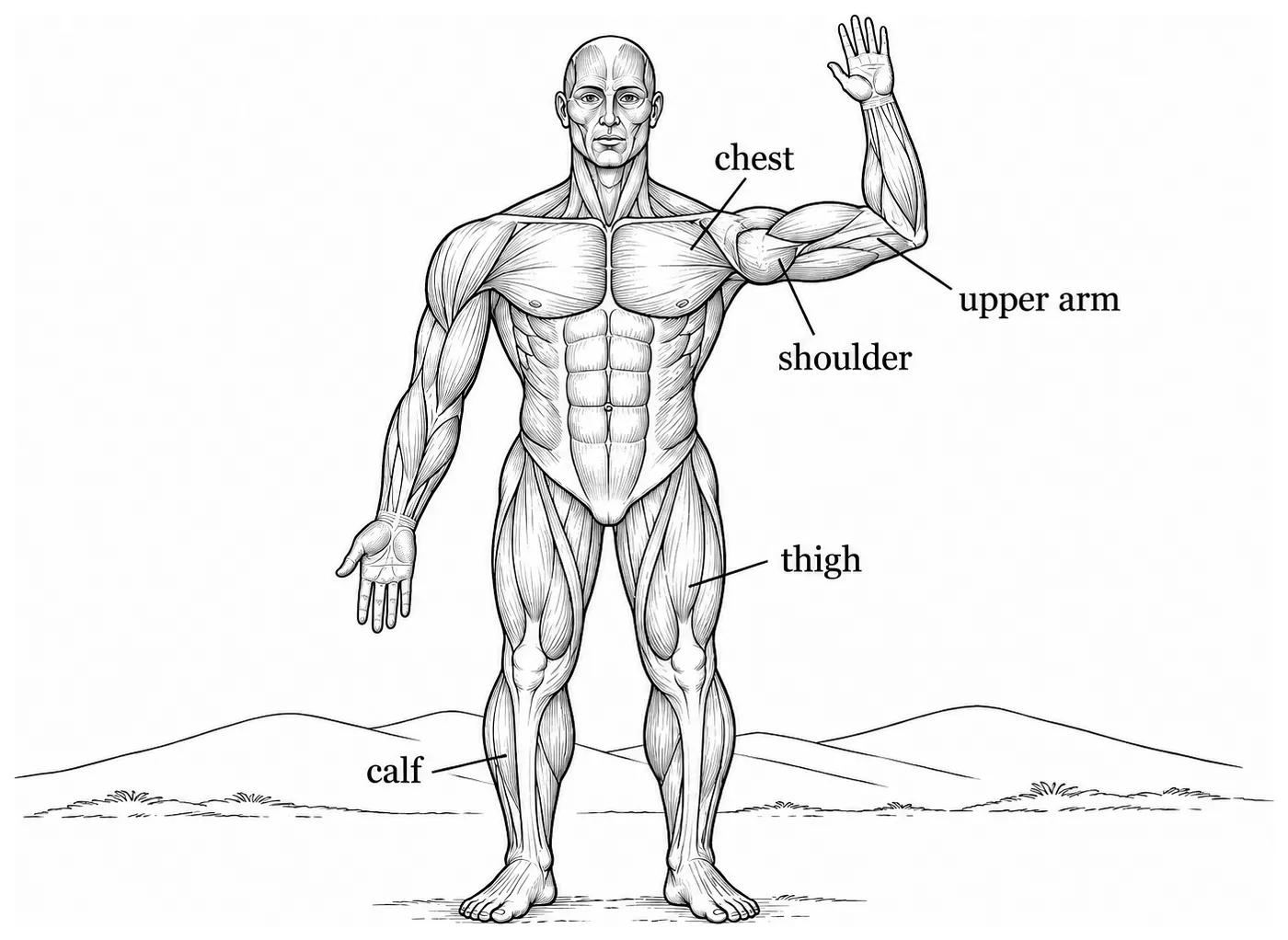
A simplified version of a Vesalian “muscle man” plate: a standing figure seen from the front with the skin removed, major muscle groups labeled (chest, shoulder, upper arm, thigh, calf), posed in a landscape
A modern drawing in the style of the muscle men in Vesalius’s book. He had the body drawn in layers, from skin to bone, so a reader could follow a dissection without a knife.Illustration from the chapter on Andreas Vesalius
Try this

Find your pulse at your wrist and count the beats in one minute. Each beat pushes out about 70 milliliters of blood, roughly a third of a cup. Multiply: a pulse of 70 moves about 5 liters a minute, which is all the blood an adult has. Your blood makes a complete circuit in a minute or less, and your heart pumps something like 7,000 liters a day.

Try this

Doctors remember the five checks with the letters of her name. Appearance (color), Pulse (heart rate), Grimace (does the baby react to a poke or a tickle of the nose), Activity (muscle tone), Respiration (breathing). Score a healthy newborn: pink body but bluish hands, 1; heart over 100 a minute, 2; cries when poked, 2; arms and legs moving, 2; strong cry, 2. Total: 9.

Questions

About Medical Pioneers

Who is in the book?

Alexander Fleming, Edward Jenner, Florence Nightingale, Jonas Salk, Hippocrates, Elizabeth Blackwell, Joseph Lister, Virginia Apgar, William Harvey, Andreas Vesalius, Daniel Hale Williams, Christiaan Barnard, Ignaz Semmelweis, Charles Drew, Helen Taussig, Rebecca Lee Crumpler, Harvey Cushing, Paul Ehrlich, Galen and Ibn Sina (Avicenna): 20 in all.

Is it good for a teen who wants to be a doctor?

Yes. It shows how medicine learned what it knows, often against fierce opposition, and how much of it depends on careful observation, counting and testing, which is the heart of the job today.

Do I need to read the other Famous in STEM books first?

No. Medical Pioneers is Volume 6 of seven, and every volume stands on its own. Each chapter does too, so readers can start with whoever interests them most.

What age is it for?

Readers 13 and up: teens, curious adults and anyone who prefers stories to textbooks. Confident younger readers who love science can read them too: the chapters are short and explain every idea from scratch.

Are the books accurate?

The 2026 editions were rewritten chapter by chapter and fact-checked against published sources. Where an anecdote rests on a single account, the books say so ("the story goes") rather than presenting legend as fact.

More in the series

Six more fields to explore

Start with the field they love.

Seven books, one for each corner of STEM. Every volume stands on its own, so there is no wrong place to begin.

Medical PioneersFamous in STEM · Vol. 6
Buy on Amazon