-
Isaac Newton
1642–1727 The plague year that changed physics
Big ideaThe force that drops an apple is the force that holds the Moon in orbit, and it obeys one simple rule.
-
Nikola Tesla
1856–1943 The man who made electricity spin
Big ideaAlternating current, which can be sent hundreds of miles and turned into motion with nothing rubbing.
-
Marie Curie
1867–1934 She boiled down tons of rock to find a glow
Big ideaSome atoms fall apart on their own and give off energy. She named it radioactivity and found two elements that do it.
-
Albert Einstein
1879–1955 The patent clerk who bent time
Big ideaLight passes everyone at the same speed, so space and time must stretch to fit. Mass is frozen energy: E = mc².
-
Daniel Bernoulli
1700–1782 The doctor who found that fast air pushes less
Big ideaAlong a smooth flow of fluid, where it moves faster, its pressure is lower. That holds up aircraft and presses racing cars onto the track.
-
Galileo Galilei
1564–1642 He pointed a spyglass at Jupiter and found four moons
Big ideaTest ideas by measuring. Without air to slow them, all objects fall at the same rate, and the Earth is not the center of everything.
-
Michael Faraday
1791–1867 The bookbinder’s apprentice who found electricity in a magnet
Big ideaMove a magnet near a wire and electricity flows. Most of the world’s electricity still comes from this.
-
Max Planck
1858–1947 The reluctant revolutionary
Big ideaEnergy comes in packets. Hot atoms can give off light only in whole packets, and bluer light comes in bigger packets.
-
Stephen Hawking
1942–2018 The man who made black holes glow
Big ideaBlack holes are not perfectly black. They leak a faint glow and, given enough time, evaporate.
-
Niels Bohr
1885–1962 The goalkeeper who built the atom out of stairs
Big ideaElectrons can sit only on certain rungs around the nucleus. When one jumps down a rung, the atom gives off light of exactly one color.
-
James Clerk Maxwell
1831–1879 Four equations, and light fell out of them
Big ideaElectricity and magnetism are one thing, and light is a wave of it. So are radio, X-rays and the signal to your phone.
-
Ole Rømer
1644–1710 He timed a moon and caught light being slow
Big ideaLight takes time to travel. When you look at anything, you see it as it was, not as it is.
-
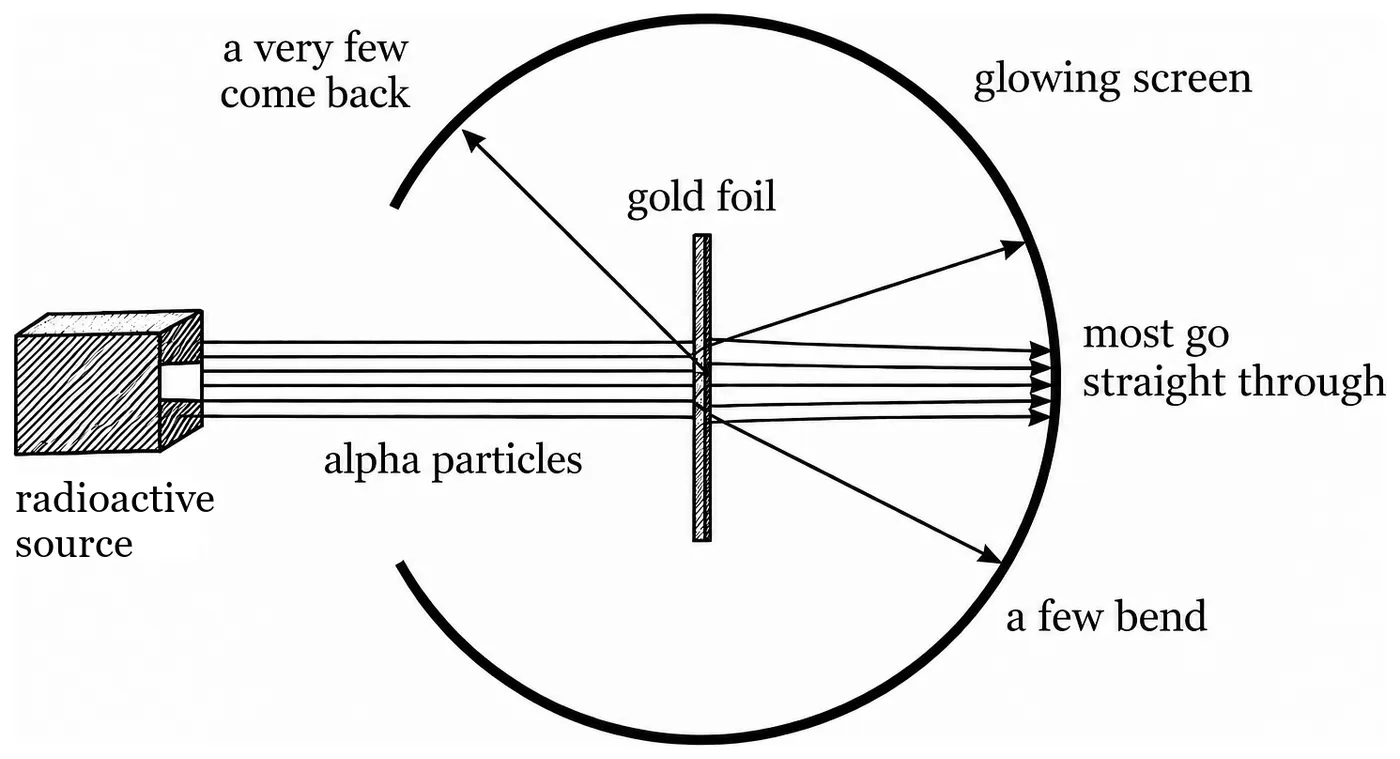
Ernest Rutherford
1871–1937 The farm boy who found the center of the atom
Big ideaAn atom is almost entirely empty space, with nearly all its mass packed into a nucleus a hundred thousand times smaller.
-
Richard Feynman
1918–1988 The physicist who drew the universe in squiggles
Big ideaEvery way a thing could happen counts a little. Add up all the possibilities and you get what we see.
-
Alessandro Volta
1745–1827 He stacked coins and wet paper and the world lit up
Big ideaTwo different metals and something salty between them make electricity flow. Stack enough and you have a battery.
-
Benjamin Franklin
1706–1790 The printer who pulled a spark from a storm cloud
Big ideaLightning is electricity, the same stuff as the spark from a doorknob, and a pointed metal rod can lead it safely into the ground.
-
Archimedes
c. 287–212 BC The man who could lift the Earth, given a place to stand
Big ideaWater pushes up on anything in it with a force equal to the weight of the water pushed aside. A long lever multiplies a small push.
-
Heinrich Hertz
1857–1894 The spark that jumped across the room
Big ideaMaxwell’s invisible waves are real. You can make them with a spark and catch them with a loop of wire.
-
Johannes Kepler
1571–1630 He threw out a theory over eight minutes of arc
Big ideaPlanets move in ellipses, not circles, speeding up near the Sun. Their orbits follow three rules that Newton later explained with gravity.
-
Georg Ohm
1789–1854 The schoolteacher who measured the push and the flow
Big ideaCurrent equals voltage divided by resistance. One short rule is behind the design of almost every circuit on Earth.
-
J. Robert Oppenheimer
1904–1967 The man who ran the project that built the bomb
Big ideaSplit one uranium nucleus and it throws out neutrons that split more. A chain reaction can release the energy locked in matter, all at once.
-
Enrico Fermi
1901–1954 He lit the first nuclear fire under a football stand
Big ideaSlow a neutron down and it is far more likely to be caught by a nucleus. With that, a chain reaction can be controlled.
-
James Chadwick
1891–1974 He found the particle with no charge, in less than three weeks
Big ideaThe nucleus holds neutrons: particles as heavy as a proton with no electric charge. They explain atomic weights and make chain reactions possible.
-
Henri Becquerel
1852–1908 The experiment that worked because the sun did not shine
Big ideaSome substances give off invisible rays with no help from anything. The atom has an energy source of its own.
-
J. J. Thomson
1856–1940 The clumsy professor who found the first piece of the atom
Big ideaAtoms are not the smallest things. Inside every one are electrons, nearly two thousand times lighter than the lightest atom.
-
Thomas Edison
1847–1931 The inventor who lit Wall Street and lost the current war
Big ideaA light bulb is useless without a system: a generator, wires, meters and a station to run it. He built the whole system, and then backed the wrong current.
 Famous in STEM